Friday, September 14, 2007

Meeting with Alan Fekete on 14/09/2007

Hendy and I had our weekly meeting with Alan Fekete today to discuss what was achieved during the last week and what we can in the following week.

The Workflow Management System (WfMS)

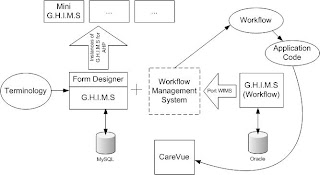
The diagram above shows the basic architecture of the WfMS for the G.H.I.M.S project. Each part is described below:

XML Schema
The XML schema describes the rules for which workflow can be instantiated in XML. The Workflow Definition Language (WFD) has been completed.


Workflow Builder
  • The Workflow Builder provide users with the ability to define their own workflow. It is based on the idea of document centric workflow system.
  • Prototype should be a simple workflow builder used to build the basic definitions of workflow but allow extensions for more complex multiple user based workflow. Simple workflow includes sequence, parallel split, synchronisation, exclusive choice and simple merge.
  • Users would be able to build basic workflows using a simple user interface. Then when the user saves the workflow, it should generate an xml output which is stored in a MySQL database.
  • The workflow builder should be able to open saved workflow documents but may not necessarily offer modifications in the prototype.

The Workflow Builder Prototype Goals

  • Design a simple user interface (possible GUI based) to allow users to construct workflow in abstract form.
  • This abstract workflow is then converted to XML in accordance with the WDL schema and stored in a MySQL database.
  • Allow read-only retrieval of workflow to show demonstrate the reconstruction of XML

Workflow Manager

  • The workflow manager takes the abstract workflow and instantiates it. Its main responsibilities include
  • Routing the workflow by delivering appropriate forms to users, requesting users to fill out forms and presenting information when requested.
  • Able to notify users at which point of the workflow they’re in.
  • Able to deliver what needs to be done
  • The workflow manager would have to obtain workflow instances from the MySQL workflow database, instantiate it and execute the workflow. In order for this to work, workflow manager must reside in the G.H.I.M.S server and interface with the Form Builder database.

Workflow Manager Prototype Goals

  • Demonstrate the construction of workflow instance from XML instance.
  • Route the appropriate forms, documents, alerts etc. to the users

Upon discussion with supervisor and the team, I have decided to attempt to build a simple Workflow Builder while Hendy will attack the Workflow Manager.

Task for the following week
For the following week, I plan to do the following:
  • Rigorously plan the design of the workflow builder - what it should ideally do, how it should do it and what resources will be needed.
  • Scope down the requirements and implement a subsection of the workflow builder. By the end of this week I hope to have the workflow builder being able to basic sequences using command prompt.

Friday, September 7, 2007

Meeting with Alan Fekete - Project rescope

Today Hendy and I had a meeting with Alan Fekete and Peter Budd to report our findings for the previous week and discuss how we could divide up the treatise into two meaningful segments.

Investigation into the use of CareVue in G.H.I.M.S ICU

The following segment describes the findings describing whether the G.H.I.M.S ICU system will rely or use CareVue.

CareVue Database Environment

  • Data is recorded by CareVue and stored into two separate databases; real time database and an historical database. The difference in both databases is that the real time database records and displays live data for recent ICU patients whereas, the archival database stores data for all ICU patients.
  • The historical database is called the Information Support Mart (ISM); a clinical data management information support mart that interfaces with CDA to create a set of approximately 30 tables from 300 tables.
  • The real time database is called the Clinical Data Archive (CDA) contains over 300 tables


Extraction of Data from CareVue for the ICU G.H.I.M.S

  • Currently, there is code written (from another project called the Ward Round System) to extract data from the historical database. As a result, we envisage that investigation into extracting data from CareVue and inputting it into an ICU G.H.I.M.S would be trival.
  • While extracting data from CareVue would be achievable, inputting the data into the database is live or archival database is problematic because:
  • We will be manipulating
  • There is a resource constraint on the access of the database.
  • Furthermore, it is envisaged that the complete ICU G.H.I.M.S would serve as a replacement to the hospitals current information system setup. Instead, de-identified CareVue data could be used as a base for data requirements analysis (as per system analysis completed) and as sample data to enter into a prototyped ICU G.H.I.M.S.

Workflow in the ICU

  • CareVue currently does not support a workflow management system.
  • There are really no standardised forms that CareVue uses during throughout the workflow in the ICU. There are certain stages and activities (e.g. automated recording of vital signs, recording of nurse discharge summaries) where there are computerised forms which are later printed out. A significant portion of clinician notes a rerecorded in free text, however some entries follow standard template (such as the Ward Round Templates).
  • Some paper forms are used during certain ICU workflows. For example, during the discharge process, medication data in CareVue is transferred by the nurse and doctors to standardised forms which are used hospital wide.

Conclusions
Considering that the proposed G.H.I.M.S would effectively be a replacement (with greater functionality and support) to any hospitals electronic or non – electronic system, CareVue should be used as a base line for which the minimal type of information could be stored on a G.H.I.M.S ICU IS. CareVue de-identified data coupled with the workflow analysis can be used as a test bed for the prototype (and full) implementation of the G.H.I.M.S. ICU IS.


The Workflow Management System


The workflow management system (shown in diagram above and in previous post) can be divided up into two independent sections - a workflow builder and a workflow manager. The workflow builder will allow users to create abstract workflow representations which then can be instantiated by the workflow manager. The workflow manager will then require to route the workflows to the appropriate users at the appropriate time. The workflow builder and workflow manager becomes the foundation for the proposed workflow management system.

The need for a workflow managment system, workflow builder and workflow manager requires some form of common ground for communication between each segments. Therefore a workflow definition language written in XML would need to be devised. This would be served as a set of rules used to describe workflows in XML much like the FDL (Forms Definition Language).

Task for the following week

For the following week, I plan to do the following:
  • Hendy and I are to work on the workflow definition language.
  • Investigate requirements and scope for the workflow builder and workflow manager.


Friday, August 31, 2007

Meeting with Jon Patrick & Alan Fekete and Project Scope

Hendy and I had a comprehensive meeting today with our supervisors Jon Patrick, Alan Fekete and Peter Budd (a PhD student who developed G.H.I.M.S and Terminology Server).


Administration


Over the next 6 weeks, Jon Patrick will be away. Temporarily taking his place as thesis supervisor will be Alan Fekete (refer to previous posts). We plan to keep in touch with Jon through regular email and progress updates on the TRAC website. We have also set up weekly meetings with Alan Fekete every Thursday at 12 mid day.


Project as of today


So far, the system analysis phase of the project has been finalised. Only minor changes need to be made which will take no longer than a couple of days. However, we are still perfoming some validation and feedback tests with Angela at the RPA (she has been unavailable this week). With the first half of the project complete, Hendy and I will diverge in our investigations in the remainder of the second phase of the project.


Project Goals for the remainder of the thesis (Project Scope)


Generally, the aim of the project is to develop a working prototype that demonstrates (a proof of concept) a document centric workflow management systems in an ICU environment.


The diagram above depicts the current state of the technology. Essentially, there are two versions of G.H.I.M.S that need to be consolidated. The version of G.H.I.M.S that was developed by Peter Budd contains a form designer with version control using a MySQL database. The second version of G.H.I.M.S, developed by William Chau, contains a workflow management systems (WfMS), written in C#, but does not contain a versioned form designer. The backend operates on an Oracle database.


In order for the system to function, investigation needs to be done to port the WfMS into Perl for it to be compatable with G.H.I.M.S developed by Peter. Open source backend, such as MySQL will also need to be implemented. Using the system and workflow analysis completed in the first half of the thesis, we have to demonstrate the generic generation of an ICU information system. In order to reduce scope, this ICU system will be a component of the ideal system that is complex enough to demonstrate a proof of concept. It is essential that several principals, on which G.H.I.M.S is based upon, are demonstrated. These are (on the top of my head):


  • Support for user workflow - adaptive workflow for the main users of an ICU information system; i.e., clinicians, nurses, allied healthcare professionals, administrators, researchers

  • Use of terminology (SNOMED-CT)

  • Customisation and Interoperability - data transfer between the ICU G.H.I.M.S and a mini (basic) G.H.I.M.S for allied healthcare professionals.

  • Extendability - ability for users to effectively define their own systems (and workflow) with the use of the form designer.

  • Medical Record storage and retreival.

My Tasks for the next week


For the following week, I plan set up the development environment on my laptop, install Peter's code and experiment with G.H.I.M.S. (I have scheduled a meeting with Peter Budd on Friday). My specific aims is to see what is required in order to make the system (bar the WfMS) to work with CareVue or to be able to mimic CareVue. This requires investigating the paper and electronic document environment surrounding the ICU's workflow and their use with CareVue and possibly, how adaptive their workflow will need to be. I plan to post an entry on adaptive workflows soon as this area is especially useful in the ICU environment.


Draft Treatise Hand In


I have finalised the draft treatised and given a copy to Alan Fekete and Jon Patrick for initial feedback. Over the next two days, I plan to work on the draft treatise extending the system analysis and workflow analysis chapters. I also have to clean up the literature review and continue to add to the literature base as I continue researching.

Sunday, August 26, 2007

Meeting with Alan Fekete 24/08/2007

With Jon Patrick being away for the week, Professor Alan Fekete took over as our thesis supervisor. Hendy and I had a meeting with him on Friday and the agenda for this week was to:
  • Update our progress with Alan Fekete.
  • Overall architecture of the proposed supervisor.
  • Requirements for literature review
  • Discuss the scope of the project

Outcomes of the meeting:

  • Need to determine the overarching architecture in which the prototype will be based on (for example, the number of servers and clients in which the system will run on). We will need to get in contact with the RPA for this information. Also, this type of informaiton will be ueful in updating the SRS for an ideal ICU system.
  • Regarding the literature review, the focus would be on:

. 1. workflow, workflow processing, workflow modelling

. 2. Management Information Systems (M.I.S)

. 3. Issues of current M.I.S

. 4. Intensive Care Information System

I plan to get an initial draft to both Alan Fekete and Jon Patrick by next Wednesday before official hand in on Friday.

Tuesday, August 21, 2007

Workflow Update

The diagram below shows the final draft of the complete work flow of an ICU unit. These diagrams still require some feed back from ICU staff.


Given that my draft thesis is due on the 31st of August (approximately 1 1/2) weeks time, I will be spending majority of the time collating and writing up, at the very least, a outline of my thesis and an initial draft of my literature review. Given that the scope is forever changing, I envisage that the initial draft to be quiet different from the final product.

Saturday, August 18, 2007

Weekly Update 06/08/07 - 17/08/07

Project Update:
It has just been two weeks since my last post. Over the past two weeks, I have been updating TRAC (a sub version repository and a wiki) about all the findings that we have gathered during our site visits at the RPA. From there, Hendy and I have been developing workflow diagrams (which seem to get ever more larger and more complex), data flow diagrams, updating an ICU SRS as well as having weekly meetings with my supervisor; Jon Patrick. Furthermore, we have also been returning to RPA to perform follow up meetings with Angela to review our work and confirm work flow diagrams. We have also begun viewing some source code with G.H.I.M.S, however, I have yet to fully look at or experiment with the code.

Project Time Management:
The system analysis phase of the project is taking longer than expected. This is mainly attributed to follow up meetings with Angela as well as the complexity of work flow diagrams (I will post an example later on) in trying to capture the varied and often chaotic work flow of an intensive care unit. Even simple processes such as discharge can be a hurdle due to the numerous legal requirements, reporting processes as well as actual management of the patient. For example work flow thus far (it is still a work in progress) is shown below:


Furthermore, the SRS for an ideal ICU will come from the interviews from RPA personnel as well as a system analysis of CareVue. As a result, we have completed a draft system review of CareVue and from there we are beginning to develop an SRS. We envisage the complete drafted SRS to be finalised by the end of this coming week.

Project Resource Management:
Over the last two weeks, I've had two meetings with Prof. Jon Patrick regarding thesis progress. The first meeting mainly consisted of providing feedback and direction relating to work flow diagrams as well as information in TRAC. The second meeting on 16/08/2007 was to discuss the progress of validating information in TRAC, re-scoping the project and Jon's availability next week. Jon is unavailable next week and will be away for several weeks from the start of September (although he will be able to be contacted via email). To take his place as IT supervisor next week and when Prof. Jon Patrick is away will be Dr Alan Fekete.

I will dedicate a separate post to the re-scoping of the project as it is a significant turning point in the thesis.

Furthermore, we have found out that Angela will be away and consequently unavailable for the next 2 weeks. While this will represents a significant strain in our resources, I see this as an opportunity to fully consolidate our findings before Angela returns. As a result, our contact within RPA for the next two weeks will be Dr. Herkes and Chris.

Task for the following week
Given the significant changes occuring, the tasks for the following week will be to:
  • Consolidate TRAC
  • Complete Work flow Diagram
  • Complete System Review/analysis of CareVue
  • Complete SRS
  • Complete DFDs
  • Review source code for G.H.I.M.S as try to get it working (while setting up develop environment on my home computer and uni computer).
  • Begin to modify G.H.I.M.S if possible.

Resource wise Hendy and I will have to:
  • Contact Dr. Alan Fekete
  • Contact Peter Budd regarding his code

Friday, August 3, 2007

Update: Week Ending 3rd August 2007

Summary of week ending 03/08/07
Hendy and I spent the majority of our time this week (Tuesday to Friday) at the Royal Prince Alfred Hospital. My main goals for the week were to:
  • Describe and document workflow of clinicians with an emphasis on their use of clinicial information systems including CareVue.
  • Map out workflow into simple diagrams.
  • System analysis of CareVue and its ability to satisfy its purpose.
  • Summaries and report any significant issues with current ICU information systems.
  • Elicit functional and non-functional requirements of an idealised ICU information system.
Week commencing 06/08/07
Hendy and I also had a detailed meeting with Jon Patrick to discuss progress and what to do next on Friday. Over the coming week, I hope to achieve the following:
  • Write up system analysis document (Draft) - contain SRS, full analysis of workflow, data flow, interview findings, etc
  • Follow up interviews/meetings with RPA to present and finalise findings.
  • Experiment with G.H.I.M.S (if time permits)
I will follow up these entries with a summary of findings over next few days.